std::filesystem Implementation Corner Cases

On this years Meeting C++
I had the chance to talk
with a lot of people and it was very inspirational. With some I talked about
ghc::filesystem
, my implementation of a
C++17 std::filesystem compatible library. Part of this discussions was about
some corner cases I found during my tests, and I was trying to remember the
details when I was having the chance to talk to @NicoJosuttis
.
He among others was interested in these issues, as they might be rooted in unclear passages of the standard.
[Update 2020-02-08: A post on stackoverflow.com showed an additional corner case, read more about it in part 2 .]

In summer 2018 I started on changing my private C++ filesystem abstraction into
a more std::filesystem conforming structure. Main motivation was the low chance of
an official implementation on my primary platform, macOS, anytime soon.
The first feature-complete public release supporting C++11, C++14 and C++17
on macOS, Windows and Linux was in September 2018.
Early on, I started writing lots of tests and wrote my test-suite in a way, that I could run
my tests against an existing std::filesystem implementation, where one is available.
The test code is based on Catch2
macros.
Currently, using the valuable services of Travis-CI and Appveyor, ghc::filesystem is
tested on GCC 5 to GCC 9, Clang 5 to Clang 9, Xcode 9/10/11 and Visual Studio 2015/2017/2019.
The tests are also run against std::filesystem in GCC 8.3 and GCC 9.3 with libstdc++ and
Clang 7.1/8.0/9.0 with libc++ and MSVC 19.16 and MSVC 19.23.
Important note:
With this post I want to share some corner cases I found, where my tests
showed different behaviour for the tested std::filesystem implementation in C++17 mode.
All tests pass on ghc::filesystem because they are from its test suite.
I have by no means the authority nor knowledge of all mails, forums, chats and other channels outside of the standard that have lead the developers to their implementation, and I might have missed an LWG-issue that is relevant here or simply missed something in the standard, so I’m not saying mine is the way to do things, and I already changed some behaviour to follow other implementations, as I’m interested in a common sense of what should happen. So I don’t want to blame anyone for anything, but some results are still irritating for me, so I keep my implementation the way it is, until I have better arguments or understanding to do otherwise.
Any opinions on any of the following “issues” is very welcome! Also new/missing corner cases are welcome to get a more complete picture!
You can reach me via twitter by @gulrak or drop me a ✉️ mail .
List of Implementation Corner Cases
path native format observers [fs.path.native.obs]
GCC 8.1, 8.2, 8.3:
FAILED:
  CHECK( fs::u8path("\xc3\xa4/\xe2\x82\xac\xf0\x9d\x84\x9e").u16string() == std::u16string(u"\u00E4/\u20AC\U0001D11E") )
due to unexpected exception with messages:
  filesystem error: Cannot convert character sequence: Illegal byte sequence
I had observed this with GCC 8.1/8.2 on Ubuntu 18.04 and macOS, and GCC 8.3.0 on Wandbox. The compiler doesn’t recognize the valid Unicode codepoint U+1D11E. This was fixed with GCC issue 90281 ).
GCC 9.2:
FAILED:
  CHECK( fs::u8path("\xc3\xa4/\xe2\x82\xac").wstring() == std::wstring(L"ä/€") )
due to unexpected exception with message:
  filesystem error: Cannot convert character sequence: Invalid or incomplete
  multibyte or wide character
This is observed on an Homebrew install of GCC-9 on macOS and on
Travis-CI Linux GCC 9.2, and with this Godbolt example
.
The std::filesystem::wstring() is the problem here, and std::filesystem::u32string()
works as expected and the returned std::u32string is the expected 3 char32_t long.
path generic format observers [fs.path.generic.obs]
GCC 9.2:
FAILED:
  CHECK( fs::u8path("\xc3\xa4/\xe2\x82\xac").generic_wstring() == std::wstring(L"ä/€") )
due to unexpected exception with message:
  filesystem error: Cannot convert character sequence: Invalid or incomplete
  multibyte or wide character
This is observed on an Homebrew install of GCC-9 on macOS and on
Travis-CI Linux GCC 9.2, and with this Godbolt example
.
The std::filesystem::generic_wstring() is the problem here, and std::filesystem::generic_u32string()
works as expected and the returned std::u32string is the expected 3 char32_t long.
path iterators [fs.path.itr]
MSVC 19.16, 19.23:
FAILED:
  CHECK( "/,foo,bar" == iterateResult(fs::path("///foo/bar")) )
with expansion:
  "/,foo,bar" == "///,foo,bar"
The used helper iterateResult is this:
static std::string iterateResult(const fs::path& path)
{
    std::ostringstream result;
    for (fs::path::const_iterator i = path.begin(); i != path.end(); ++i) {
        if (i != path.begin()) {
            result << ",";
        }
        result << i->generic_string();
    }
    return result.str();
}
GCC, Clang and my implementation all return / for the /// part, only
MSVC decides to return ///. As Windows is supporting / as seperator too,
even if it’s not the preferred seperator, I’m not sure about this and I didn’t mimic
this behaviour on Windows.
path inserter and extractor [fs.path.io]
MSVC 19.16, 19.23:
With an std::ostringstream filled by:
std::ostringstream os;
os << fs::path("/root/foo bar");
we get this failure:
FAILED:
  CHECK( os.str() == "\"\\\\root\\\\foo bar\"" )
with expansion:
  ""/root/foo bar"" == ""\\root\\foo bar""
The standard describes the effect of the path inserter as: “Equivalent to: os « quoted(p.string<charT, traits>());” and fs::path::string() is one of the native format observers that MSVC returns a backslashed path for. Still the stream inserter outputs the generic format (that Windows API will accept) and this seems inconsistent.
directory entry [fs.dir.entry]
  fs::directory_entry none;
  none.refresh();
This code currently throws an exception on MSVC 19.16, 19.23 and ghc::filesystem while not
throwing on all versions of GCC/Clang.
  fs::directory_entry de;
  de.assign("");
This code currently only throws on MSVC 19.16 and ghc::filesystem.
  fs::directory_entry de{"existing_dir/existing_file"};
  de.replace_filename("bar");
This code currently only throws on MSVC 19.16 and ghc::filesystem.
MSVC 19.23:
  auto none = fs::directory_entry();
  CHECK( none.status().type() == fs::file_type::not_found );
FAILED:
  CHECK( none.status().type() == fs::file_type::not_found )
with expansion:
  2 == 1
This is surprizing. I have no idea why this happens, als 2 would be
fs::file_type::regular for a directory_entry with an empty path.
absolute [fs.op.absolute]
GCC 8.3, 9.2:
FAILED:
  CHECK( fs::absolute("") == fs::current_path() / "" )
due to unexpected exception with message:
  filesystem error: cannot make absolute path: Invalid argument
GCC is the only one throwing in this case, or sets the error_core in case of
fs::absolute(error_code&), besides the standard note: “Implementations are
strongly encouraged to not query secondary storage, and not consider !exists(p)
an error.” and the example implementation from the standard:
“For POSIX-based operating systems, absolute(p) is simply current_path()/p.”.
MSVC 19.16, 19.23:
FAILED:
  CHECK( fs::absolute("") == fs::current_path() / "" )
with expansion:
  "" == "C:\projects\filesystem\build\"
MSVC is returning an empty result.
Others
Clang and my implementation return the suggested result of current_path()/p.
canonical [fs.op.canonical]
Clang 7, 8, 9, MSVC 19.16, 19.23:
FAILED:
  CHECK_THROWS_AS( fs::canonical(""), fs::filesystem_error )
because no exception was thrown where one was expected:
This seems to be a violation of the standard, as 30.10.15.2 (4) specifies
"!exists(p) is an error." and the compilers report false for exists("").
My guess is, Clang first calls absolute(p) and after that, p is not empty
and exists(absolute("")) is normally true as it is the current directory path.
The GCC implementations treat this as an error, as well as my own.
create_directory, create_directories
[fs.op.create_directory], [fs.op.create_directories]
Given a p with:
auto p = fs::path{"some_existing_regular_file"};
We get:
GCC 7, MSVC 19.16:
FAILED:
  CHECK_THROWS_AS( fs::create_directories(p), fs::filesystem_error )
because no exception was thrown where one was expected
Clang 7, 8, 9 and MSVC 19.16:
FAILED:
  CHECK_THROWS_AS( fs::create_directory(p), fs::filesystem_error )
because no exception was thrown where one was expected
This was not well defined with the original standard and the LWG#2935 suggested this behaviour. The more intuitive approach to directory creation of treating a file with that name as an error is also advocated by the newer paper WG21 P1164R0 , the revison P1161R1 was agreed upon on Kona 2019 meeting see merge and MSVC and GCC by now switched to following its proposal (GCC #86910 ).
equivalent [fs.op.equivalent]
GCC 8.x, 9.2:
  CHECK_THROWS_AS( fs::equivalent("foo", "foo3"), fs::filesystem_error )
because no exception was thrown where one was expected:
  This test expects LWG #2937 result conformance.

  CHECK( ec )
with expansion:
  system:0
with message:
  This test expects LWG #2937 result conformance.

  CHECK_THROWS_AS( fs::equivalent("foo3", "foo"), fs::filesystem_error )
because no exception was thrown where one was expected:
  This test expects LWG #2937 result conformance.

  CHECK( ec )
with expansion:
  system:0
with message:
  This test expects LWG #2937 result conformance.
With LWG #2937 was specified, that it is an error if either of the given path objects doesn’t resolve to an existing file and Clang and MSVC follow #2937. My implementation follows this rule too (but there is a define at the top, where this can be disabled).
weakly_canonical [fs.op.weakly_canonical]
Clang 7, 8, 9 and GCC 8.3, 9.2:
FAILED:
  CHECK( fs::weakly_canonical("") == "." )
with expansion:
  "/home/travis/build/gulrak/filesystem/build"
  ==
  "."
Clang and GCC are returning fs::current_path() for fs::canonical("") so it is to be expected
that they return the same for fs::weakly_canonical(""). MSVC and my implementation are
returning . as the normalized empty path ([fs.def.normal.form], 8).
Raw Test Issue Table
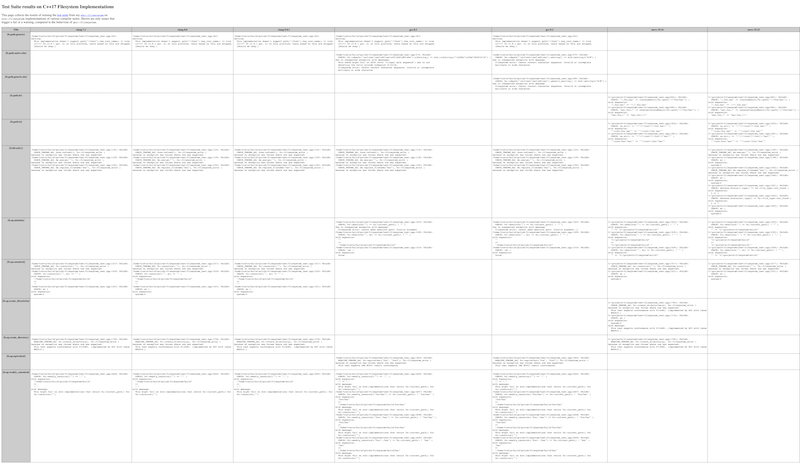
I wrote a script generating an html table with the issues ordered by category and compiler and I try to reupload a new one, if something relevant changes. I’ll link to it only for completeness:
Thanks!
I would like to thank Jonathan Wakely, whom I had contact with through my last GCCs issues, for taking me serious and for pointing me to the right directions a few times. He was always helpful and quick in fixing actual issues I found and reported.
I also want to thank Nico Josuttis for his
WG21 P1164R0
to clear up the create_directory/create_directories issue, his efforts to
make the standard clearer for normal developers and his
C++17 - The Complete Guide
.
And thanks to all those I talked to on Meeting C++ but can not list here, I hope to meet many of you next year.